API Security Explained: How to Protect Your Applications
Modern applications depend heavily on APIs (Application Programming Interfaces). From mobile applications and banking platforms to cloud services and business management systems, APIs allow different...
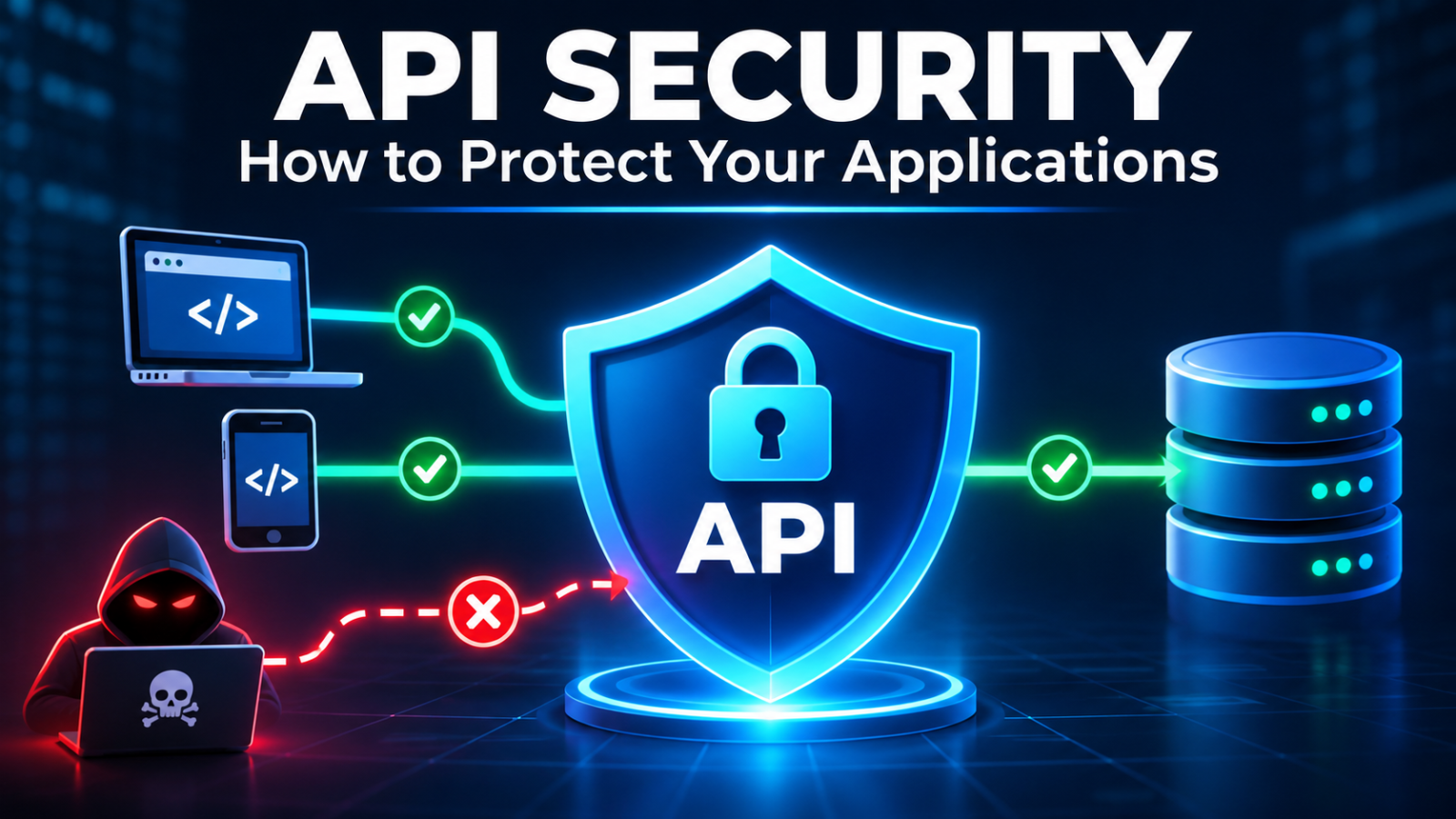
Modern applications depend heavily on APIs (Application Programming Interfaces). From mobile applications and banking platforms to cloud services and business management systems, APIs allow different applications to communicate and exchange information.
However, when APIs are poorly secured, they can become an entry point for cybercriminals to steal sensitive data, compromise user accounts, and gain unauthorized access to business systems.
An application can have a secure login page and encrypted connections while still exposing critical information through a vulnerable API.
1. What Is an API, and Why Is API Security Important?
An API allows software applications to communicate with one another through defined requests and responses.
For example, a medical clinic application may use an API to retrieve patient information from a cloud server, while an e-commerce website uses APIs to manage customers, orders, and payments.
APIs frequently handle confidential data, including usernames, authentication tokens, financial records, and personal information.
If an API does not properly validate requests or enforce access permissions, attackers may exploit these weaknesses.
According to the OWASP API Security Top 10, broken authorization, authentication failures, and security misconfigurations are among the major risks affecting modern APIs.
2. Broken Authorization: Accessing Another User's Data
One of the most serious API vulnerabilities is Broken Object Level Authorization (BOLA).
Imagine a medical application retrieving a patient record using this API endpoint:
GET /api/patients/1001
A properly secured application verifies that the authenticated user has permission to access patient 1001.
However, if the server trusts the requested patient ID without checking authorization, changing that identifier could potentially expose another patient's information.
The problem is not necessarily that the user bypassed authentication.
The user may already be legitimately logged in.
The vulnerability occurs when the server fails to verify whether that user is authorized to access the requested resource.
To prevent this, developers must enforce object-level authorization checks on the server for every sensitive request.
3. Weak Authentication and Stolen API Tokens
Many modern APIs use access tokens, including JSON Web Tokens (JWTs) or OAuth access tokens, to authenticate requests.
Attackers may obtain these credentials through malware, exposed logs, insecure storage, or application vulnerabilities.
If a stolen token remains valid and unrestricted, it may provide access to protected API resources.
Developers should implement:
Short-lived access tokens where appropriate.
Secure token storage and transmission.
Strong token signature, issuer, audience, and expiration validation.
Token revocation and refresh-token protection.
Multi-factor authentication for sensitive accounts.
Least-privilege scopes and permissions.
For supported OAuth implementations, sender-constrained tokens and refresh-token rotation can reduce certain token replay risks.
Security insight: Authentication confirms who is making a request. Authorization determines what that identity is allowed to do. Both must be enforced.
4. SQL Injection and Untrusted API Input
APIs often interact directly with databases.
When developers construct database queries using untrusted input, attackers may exploit SQL injection vulnerabilities.
This can potentially expose sensitive records, modify data, or compromise database integrity.
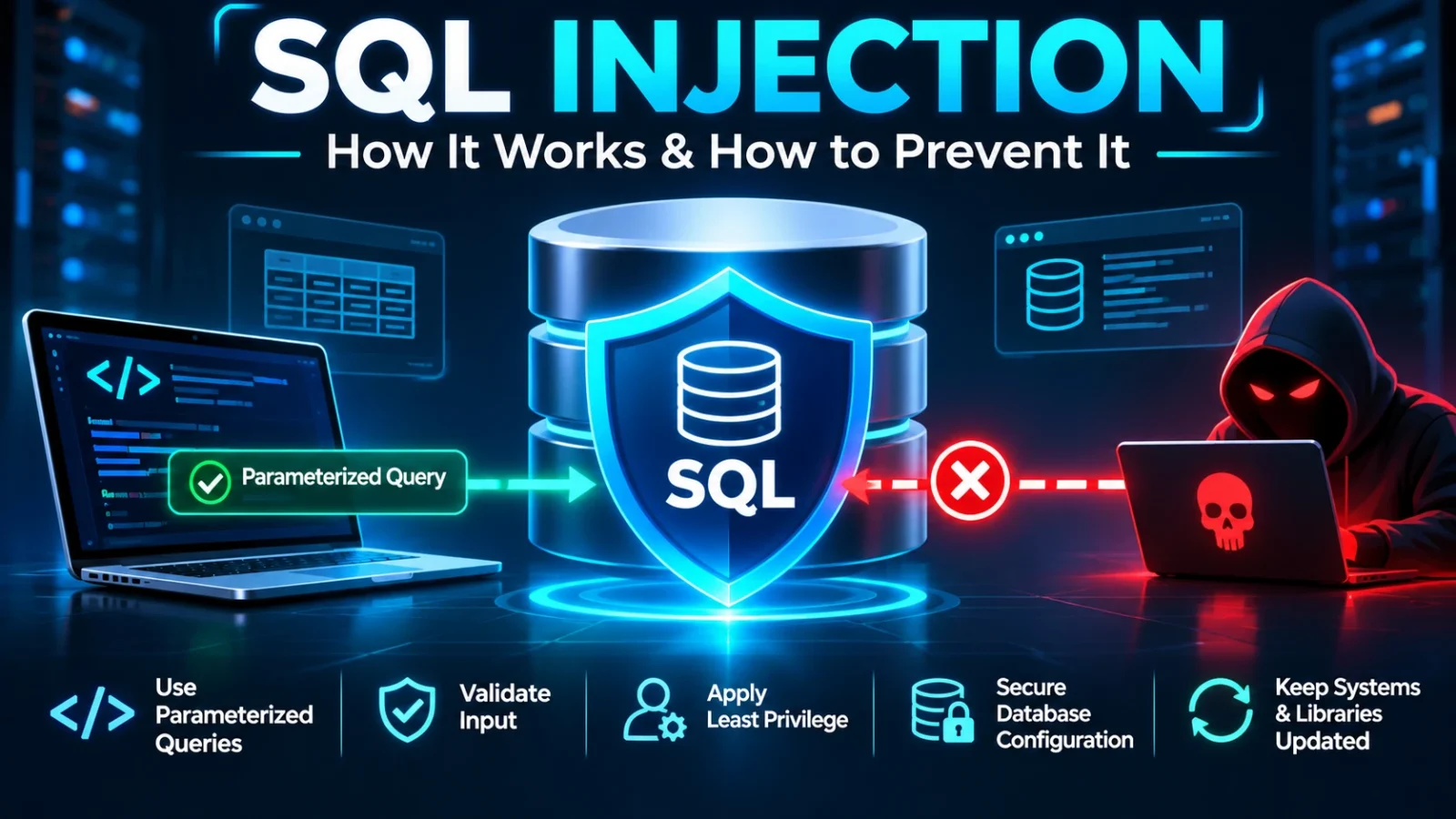
Applications should use parameterized queries or properly implemented Object-Relational Mapping (ORM) frameworks.
Developers should also validate request data, enforce appropriate data types, and ensure database accounts have only the permissions necessary for their operations.
Input validation is important, but it is not a substitute for parameterized database access.
5. Rate Limiting and Automated API Abuse
Cybercriminals frequently use automation to send large numbers of API requests.
These requests may target login systems, consume excessive server resources, or abuse business functions.
Without proper restrictions, an attacker could overwhelm an API or exploit expensive operations to increase infrastructure costs.
Developers should implement rate limits, request-size restrictions, timeouts, resource quotas, and monitoring for unusual traffic patterns.
However, rate limiting alone does not prevent every attack.
For sensitive operations, businesses should combine these controls with authorization checks and abuse detection.
6. Protecting Sensitive Information in API Responses
Another common security mistake is returning more information than an application actually needs.
For example, a patient-management API might return an entire database object when the application only requires a patient's name and appointment date.
This could accidentally expose confidential fields.
APIs should return only explicitly approved data and enforce field-level authorization.
Sensitive information such as passwords, private keys, and authentication secrets should never appear in ordinary API responses.
Passwords must be stored using appropriate password-hashing methods, not reversible encryption.
7. Essential API Security Best Practices
Businesses and developers should adopt the following protections:
Use HTTPS: Protect API traffic using properly configured TLS.
Enforce authorization: Verify permissions on every sensitive endpoint and resource.
Secure authentication: Use established authentication standards and protect tokens.
Validate input: Reject malformed requests and use safe database query methods.
Apply rate limiting: Restrict automated abuse and excessive resource consumption.
Protect secrets: Keep API keys and credentials out of public repositories and client-side code.
Monitor API activity: Log suspicious requests, authentication failures, and unusual access patterns.
Maintain an API inventory: Remove unused endpoints, patch dependencies, and document active API versions.
For high-risk applications, organizations should also perform regular security assessments based on the OWASP API Security Top 10.
8. Why API Security Matters for Businesses
A vulnerable API can expose far more than an individual user account.
In a medical system, it could expose confidential patient records.
In an e-commerce platform, it could reveal customer information and order details.
In a financial application, it could allow unauthorized transactions or access to payment information.
The financial and reputational consequences of a serious API breach can be substantial.
API security should therefore be part of application architecture from the beginning, not an additional feature implemented after deployment.
Final Thoughts
APIs are essential to modern software, but their connectivity also makes them attractive targets for cybercriminals.
Strong authentication, proper authorization, secure token management, input validation, and continuous monitoring help protect applications against common API attacks.
Organizations must also remember that protecting an application interface is not the same as protecting the systems behind it.
Every API request should be validated according to the identity, permissions, and business rules applicable to that operation.
Remember: A secure application starts with a secure API. Never trust a request simply because it comes from your own application.