SQL Injection Explained: How It Works and How to Prevent It
A single vulnerable database query can expose thousands of customer records, compromise administrator accounts, or allow attackers to manipulate sensitive business information. This is the danger of...
A single vulnerable database query can expose thousands of customer records, compromise administrator accounts, or allow attackers to manipulate sensitive business information.
This is the danger of SQL Injection (SQLi), a well-known cybersecurity vulnerability that continues to affect websites, APIs, and business applications.
Despite being understood for decades, SQL injection remains a serious security risk because developers sometimes allow untrusted input to become part of executable database commands.
1. What Is SQL Injection?
SQL Injection is a vulnerability that occurs when an application improperly incorporates user-controlled input into a SQL database query.
Applications use SQL (Structured Query Language) to retrieve, insert, update, and delete information stored in databases such as Microsoft SQL Server, MySQL, and PostgreSQL.
When an application constructs SQL statements unsafely, attackers may be able to manipulate the intended query.
Depending on the vulnerability and database permissions, this can expose confidential information, bypass application controls, or modify stored records.
Cybersecurity insight: SQL injection exploits unsafe query construction, not a fundamental weakness in SQL databases themselves.
2. How Does SQL Injection Work?
Consider a website that allows users to search for customer information.
When a user enters a name, the application generates a database query to retrieve matching records.
A simplified query might look like this:
SELECT * FROM customers WHERE name = 'John';
This query is legitimate when the value is handled safely.
The vulnerability appears when developers build SQL commands by directly combining user input with query strings.
An attacker may supply specially constructed input that changes the SQL statement's meaning.
Instead of treating the submitted value as ordinary data, the database may interpret part of it as SQL instructions.
A successful attack could cause the application to return unauthorized information or execute unintended database operations.
This risk can appear in login forms, search fields, URL parameters, API requests, and even data previously saved in a database.
3. Common Types of SQL Injection Attacks
Security professionals generally recognize several SQL injection techniques.
In-Band SQL Injection
The attacker uses the same communication channel to exploit the vulnerability and receive information.
For example, a vulnerable application might unintentionally display unauthorized database results directly in its response.
Blind SQL Injection
Sometimes an application does not display database records or detailed error messages.
Attackers may still infer information by analyzing how the application responds to different conditions.
Two commonly discussed forms are Boolean-based and time-based blind SQL injection.
Out-of-Band SQL Injection
In certain database environments, attackers may exploit additional database capabilities to transmit information through a separate communication channel.
This depends on the database technology, configuration, and permissions available to the application.
4. What Can Hackers Do With SQL Injection?
The impact of SQL injection depends heavily on the application's security architecture and database privileges.
Potential consequences include:
Data theft: Exposure of customer information, financial records, or confidential business data.
Authentication bypass: Manipulation of vulnerable login or authorization queries.
Data modification: Unauthorized changes to application records.
Data deletion: Destruction of important business information.
Privilege escalation: Access to database operations beyond the application's intended permissions.
Service disruption: Database operations that affect application availability.
For businesses handling healthcare records, financial transactions, or customer information, a serious SQL injection vulnerability can create significant financial and legal consequences.
5. A Practical Example: Vulnerable vs. Secure SQL Queries
Consider a C# application that retrieves information from Microsoft SQL Server.
An insecure implementation might construct a query like this:
"SELECT * FROM Users WHERE Email = '" + userEmail + "'"
The problem is that userEmail becomes part of the SQL command itself.
If the value contains SQL syntax, it may change how the query is interpreted.
The Secure Approach: Parameterized Queries
A safer implementation separates the SQL statement from its data:
SELECT * FROM Users WHERE Email = @Email
The application then binds the user's email address to the @Email parameter using the database driver's parameter API.
The database processes the supplied value as data rather than executable SQL syntax.
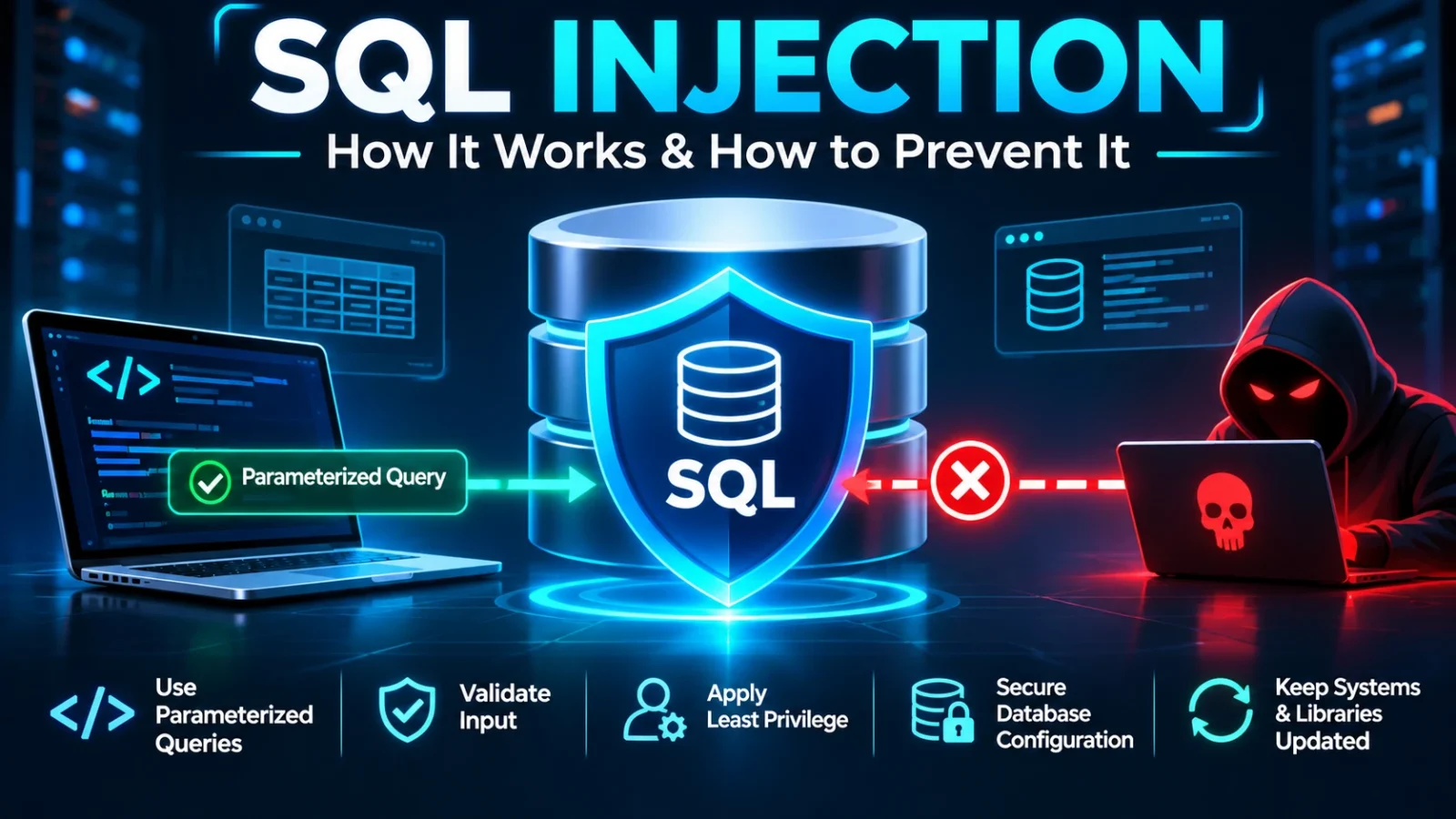
This approach is called a parameterized query, and it is one of the most important defenses against SQL injection.
The same principle applies to PHP, Python, Java, C#, and other programming languages.
6. How Can Developers Prevent SQL Injection?
Preventing SQL injection requires secure application design, proper database permissions, and regular testing.
1. Always Use Parameterized Queries
Use prepared statements or parameterized database commands instead of building SQL statements through string concatenation.
2. Validate User Input
Verify expected data types, lengths, and formats. For SQL elements that cannot be parameterized, such as column names or sort directions, use strictly predefined allowed values.
Input validation complements parameterization but does not replace it.
3. Apply Least-Privilege Database Access
Applications should connect to databases using accounts with only the permissions necessary for their operations.
A customer-facing application generally should not connect using a database administrator account.
4. Secure Stored Procedures
Stored procedures can improve security when implemented correctly.
However, they can still contain SQL injection vulnerabilities if they construct dynamic queries using untrusted input.
5. Use Web Application Firewalls (WAF)
A WAF may detect and block suspicious requests associated with SQL injection.
However, attackers can sometimes evade filtering, so a WAF should never replace secure coding practices.
6. Conduct Regular Security Testing
Use code reviews, static application security testing, and authorized penetration testing to identify unsafe queries before attackers discover them.
7. Protect Database Infrastructure
Keep database systems updated, restrict network access, monitor unusual database activity, and maintain tested backups.
7. Why SQL Injection Is Still a Business Threat
Many organizations invest in firewalls, endpoint protection, and cloud security while overlooking vulnerabilities in their own application code.
An API or web application may be protected by HTTPS and strong authentication but still contain a SQL injection vulnerability.
Encryption protects information during transmission. It does not prevent a database from executing an improperly constructed query.
For this reason, security must be implemented at the application and database layers.
Final Thoughts
SQL injection remains a serious cybersecurity threat because it can turn ordinary application input into unauthorized database operations.
The most effective defense is straightforward: never combine untrusted data directly with executable SQL commands.
By using parameterized queries, limiting database permissions, validating application inputs, and performing regular security assessments, developers can significantly reduce the risk of SQL injection.
A database is only as secure as the application and permissions used to access it.