Email Spoofing vs. Domain Spoofing: Differences and Protection
Imagine receiving an email from your company's bank requesting immediate verification of your account. The sender's name looks familiar, the email appears professional, and even the domain seems...
Imagine receiving an email from your company's bank requesting immediate verification of your account. The sender's name looks familiar, the email appears professional, and even the domain seems legitimate.
But the message was sent by a cybercriminal.
This is how email spoofing and domain spoofing are used to deceive individuals, steal credentials, and compromise businesses.
Although these techniques are closely related, understanding their differences can help organizations recognize suspicious communications before they cause financial damage.
1. What Is Email Spoofing?
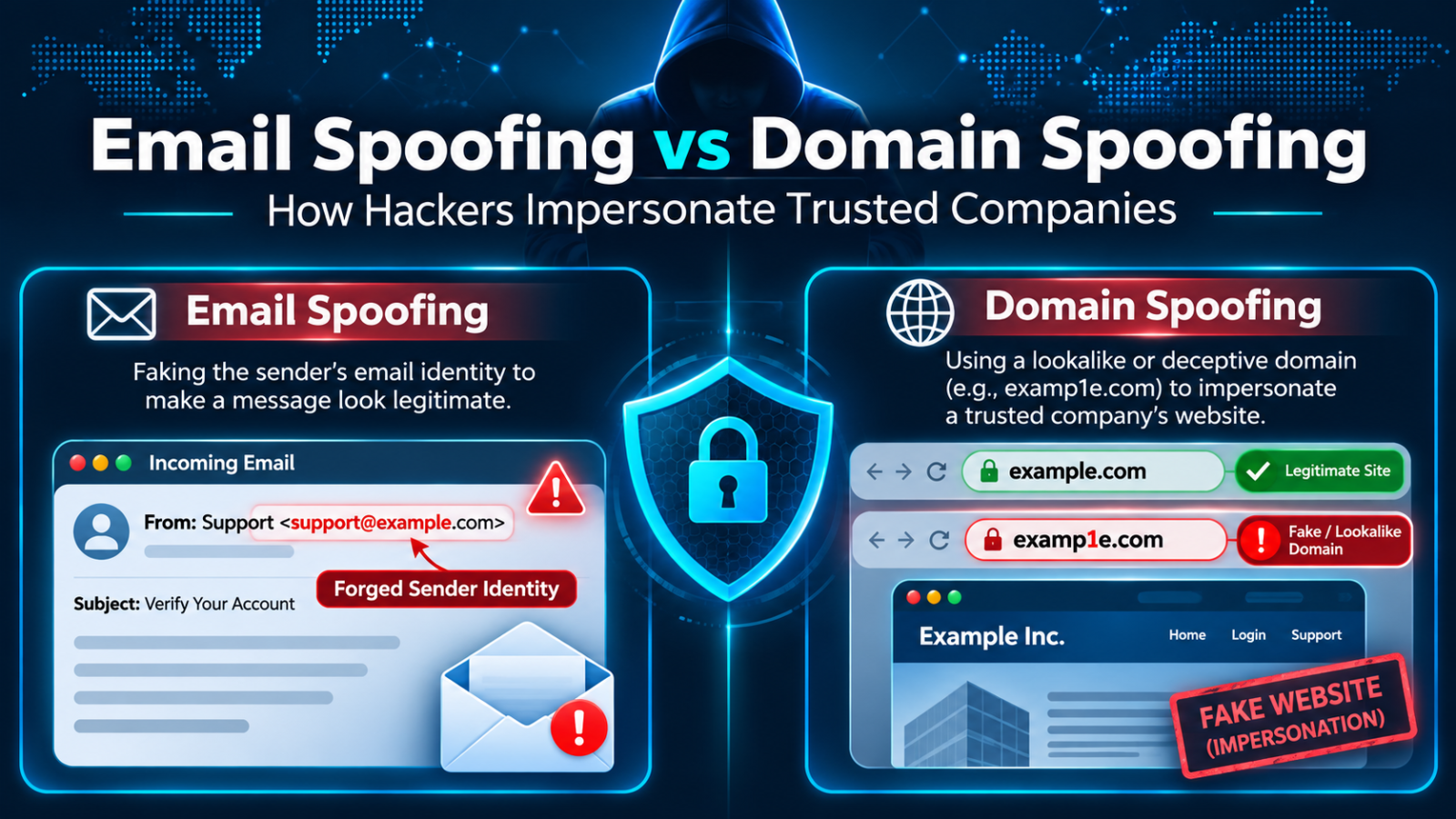
Email spoofing occurs when an attacker falsifies email header information to make a message appear to originate from someone else.
Traditional email protocols do not inherently guarantee that the address displayed in the From field belongs to the actual sender.
Attackers exploit this weakness to impersonate company executives, financial institutions, suppliers, and trusted employees.
For example, an attacker might send an email displaying:
From: ceo@example.com
The actual sending infrastructure, however, is not authorized by example.com.
The message might request an urgent payment, confidential company information, or employee login credentials.
How Does Email Spoofing Work?
Email messages contain multiple sender identities, including the visible From address and the SMTP envelope sender.
These identities do not necessarily match.
Cybercriminals can manipulate the visible sender information to make fraudulent messages look authentic.
Without effective authentication checks, recipients may have difficulty recognizing the impersonation.
Cybersecurity insight: The sender address displayed in an email application is not sufficient proof of the sender's identity.
2. What Is Domain Spoofing?
Domain spoofing is a broader form of impersonation in which attackers make a website or email domain appear to belong to a trusted organization.
It can involve forging an existing domain or creating a visually similar one.
One particularly common technique is registering a lookalike domain, also known as typosquatting or domain impersonation.
For example:
Legitimate domain: example.com
Lookalike domain: examp1e.com
Notice how the lowercase letter l has been replaced with the number 1.
At first glance, the two addresses may appear nearly identical.
Attackers can register these deceptive domains, create professional-looking email addresses, and even build fake websites resembling the legitimate company's website.
Unlike exact-address email spoofing, an attacker operating a lookalike domain may control that domain and configure valid email authentication for it.
This makes lookalike-domain attacks particularly dangerous.
3. Email Spoofing vs. Domain Spoofing: What's the Difference?
| Email Spoofing | Domain Spoofing |
|---|---|
| Forges email sender information | Impersonates a legitimate domain or brand |
| Typically targets email communication | Can target emails and websites |
| May display an exact legitimate email address | May use deceptive lookalike domain names |
| Can be detected through email authentication | May pass authentication for attacker-owned domains |
These categories overlap: spoofing an organization's exact email domain is itself a form of domain spoofing.
The useful distinction is between forging a sender identity and using a deceptive domain that an attacker actually controls.
4. How Hackers Use These Techniques in Real Attacks
Consider a business expecting an invoice from a trusted supplier.
An attacker registers a domain almost identical to the supplier's legitimate domain.
The attacker then sends an email requesting payment to updated banking details.
Because the sender address looks familiar, the accounting department might process the transfer without independently verifying the request.
The payment is sent to an attacker-controlled account.
This type of deception is frequently associated with Business Email Compromise (BEC), phishing, and invoice fraud.
In other cases, attackers use spoofed emails to distribute malicious attachments or direct employees toward fraudulent login pages.
5. Can SPF, DKIM, and DMARC Prevent Spoofing?
Three important email authentication technologies help businesses protect their domains.
SPF (Sender Policy Framework) identifies which mail servers are authorized to send email using a domain's SMTP sending identity.
DKIM (DomainKeys Identified Mail) uses digital signatures to verify that a domain signed an email and that protected content has not been altered.
DMARC (Domain-based Message Authentication, Reporting, and Conformance) verifies whether authenticated domains align with the visible From address and lets domain owners publish policies for authentication failures.
Together, these protocols significantly reduce the risk of successful direct domain spoofing.
However, SPF, DKIM, and DMARC cannot completely prevent lookalike-domain attacks.
An attacker who owns examp1e.com can configure valid authentication records for that domain.
Its messages may pass authentication while still attempting to impersonate example.com.
This is why businesses need additional impersonation detection and employee awareness.
6. How Can Businesses Protect Themselves?
Organizations should implement several security measures:
Configure SPF, DKIM, and DMARC: Protect your legitimate email domains with correctly aligned authentication and an appropriate DMARC enforcement policy.
Enable advanced anti-phishing protection: Use email security tools that detect suspicious sender identities and lookalike domains.
Verify financial instructions: Always confirm banking changes and unusual payment requests through an independently verified communication channel.
Monitor domain impersonation: Watch for newly registered domains that closely resemble your business identity.
Enable Multi-Factor Authentication: Protect employee mailboxes against account takeover, ideally using phishing-resistant methods.
Train employees: Teach staff to inspect full sender addresses, recognize suspicious requests, and report potential phishing attempts.
Even a perfectly configured email security environment cannot eliminate every form of social engineering.
Final Thoughts
Email spoofing and domain spoofing remain effective cybercriminal techniques because they exploit trust in familiar names, companies, and online identities.
Email spoofing commonly involves falsifying sender information, while domain impersonation may involve registering deceptive addresses or creating fraudulent websites.
Both techniques can lead to financial fraud, credential theft, and unauthorized access to business systems.
Organizations should combine SPF, DKIM, DMARC, advanced phishing detection, account security, and independent verification procedures.
Remember: An email that looks legitimate is not necessarily authentic. Always verify the sender before sharing sensitive information or transferring money.